Owner Longshank Hooks

The Owner long shank hooks are traditionally used for rigging bait fish.  BUT! They work exceptional well for rigging large soft plastic baits; particularly long and large profile swim baits (a.k.a “paddle tails” or “swim shads”).
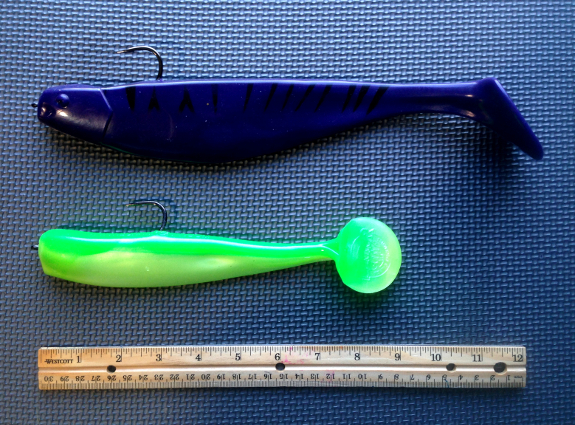
Owner Longshank Hook Swim Bait

Large solid soft plastic swimbaits have some buoyancy. To get them to swim consistently below the water’s surface, I add weight. There are a variety of materials that can be used for weight. Chemically speak, tungsten (W, 19.25 g/cm3) is denser than lead (Pb, 11.34 g/cm3). Lead is denser than copper (Cu, 8.96 g/cm3). Copper is denser than steel (C+Fe,7.75 g/cm3). And steel is denser than tin (Sn, 7.31 g/cm3). I use a variety of materials based on depth and regulations.
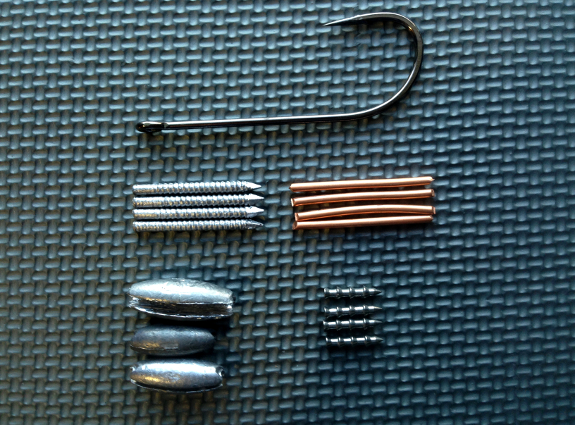
Owner Longshank Hook Swim Bait

For “shallow” running depths, I use insert weights made from tungsten, lead, or copper.  I secure them to the shank via thread and epoxy. For thread, you can use fly tying thread or recycled braided line. The latter allows you to really tighten the weights to the hook shank.

Owner Longshank Hook Swim Bait

For “deeper” running depths, I use rubber core sinkers made from lead or steel. I remove the rubber core and bore out the channel with a power drill to accommodate the hook shank. Once the hook sits level inside the channel, I clamp the sinker onto the shank of the hook via vice grip pliers.
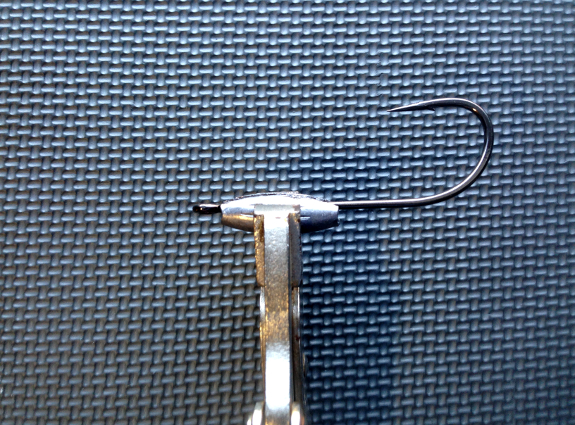
Owner Longshank Hook Swim Bait

Solid body soft plastic swim baits can easily accommodate the diameter of a hook’s shank.  But, increasing that diameter with weights can cause splitting. Hence, I exploit a power drill and drill bits.
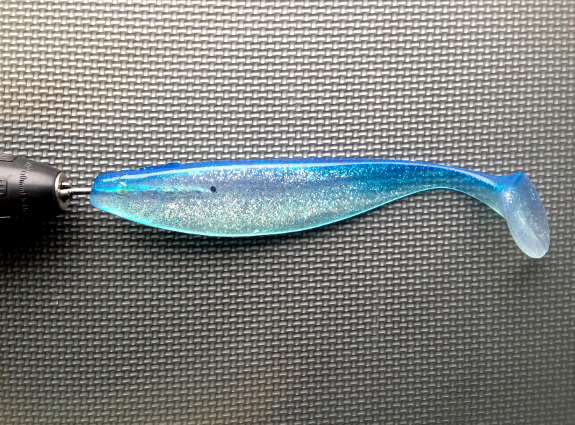
Owner Longshank Hook Swim Bait

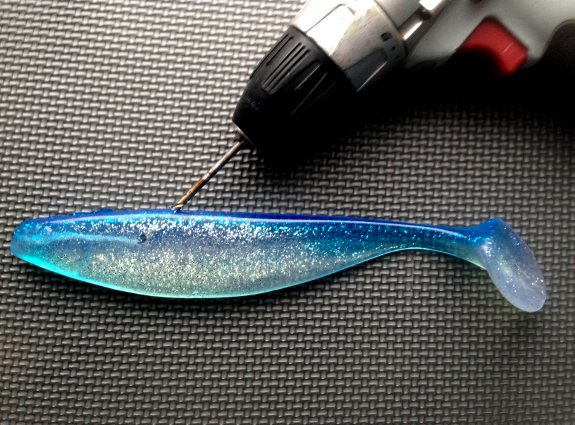
I align the Owner long shank hook on the side of the swimbait. I make a mark on the side where the hook starts to bend. I also make a mark where the hook will penetrate from the top of the swimbait.
Owner Longshank Hook Swim Bait

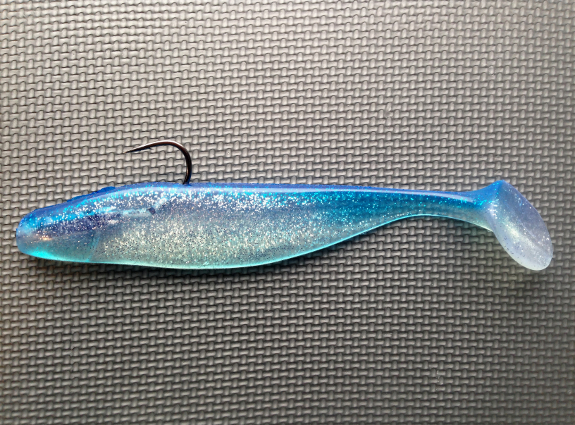
I drill a hole through the nose of swim bait until the point where the hook starts to bend. I then drill a hole a 45 degree angle where the point of the hook will penetrate the top of the swim bait. This channel will allow the hook to be inserted into the swimbait at the exact position. To accommodate the weight’s length and diameter, I enlarge part of the channel using an appropriately sized drill bit.
Owner Longshank Hook Swim Bait

The position of the weights on the shank will alter the action of the swimbait.  Mounting the weights near the eye of the hook will cause the swimbait to head dive and swim with the paddle tail upwards.  Mounting the weights towards the center of the hook will cause the soft plastic to fall and swim level.  Each action has it’s application. I use the former to target fish holding on bottom or near structure. I use the latter to target suspending fish.

Rigging long and large profile soft plastic swimbaits with Owner long shank hooks with various weights (1/16 oz to 1 oz) will allow you to fish them at precise depths in the water column.  Such versatility is unmatched by commercially available swimbaits with embedded weights, which tend to have increasing weight with increasing length.


Facebooktwitterlinkedin

DIY Bobber

A bobber is a great way to present bait at a specific depth below the water’s surface. There are several commercial bobbers on the market in various sizes, geometries, and colors. However, you are not limited to what’s available in the marketplace. With some simple tools and materials, you can make your own bobber to fish a variety of baits in a variety of conditions.

Fish360 DIY Bobber

Materials

  • Wine Bottle Cork
  • Monofilament or flurocarbon
  • Hook
  • Swivel
  • Split shot (optional)

Tools

  • Safety Glasses
  • Line cutter or scissors
  • Rigging Needle (e.g. Carp Bait Needle)
  • Pliers (optional)

Making your own bobbers is easy. Cut a length of monofilament or flurocarbon to fish your desired depth; be sure to add addition lengths for knots. Tie the length of monofilament or flurocarbon to a swivel via improved clinch knot . Tie a double surgeon’s loop to the other end of the leader. Insert a rigging needle through the enter of a wine bottle cork and hook the loop.

Fishd360 DIY Bobber Part I

Pull the line through the cork until the bottom eye of the swivel touches the cork.  Push bottom eye of the swivel into the cork.  Cut the double surgeons loop knot and tie a hook of your choice via improved clinch knot . Depending on your application, you can add a non-lead split spot.

Fishd360 DIY Bobber Part II

Besides being very low cost (excluding the cost of the wine), the primary advantage of this DIY bobber is that it provides maximum buoyancy with a minimal profile. I personally think that cork has more of a natural look than a red/white plastic sphere. 😉

Facebooktwitterlinkedin

Plug Colors

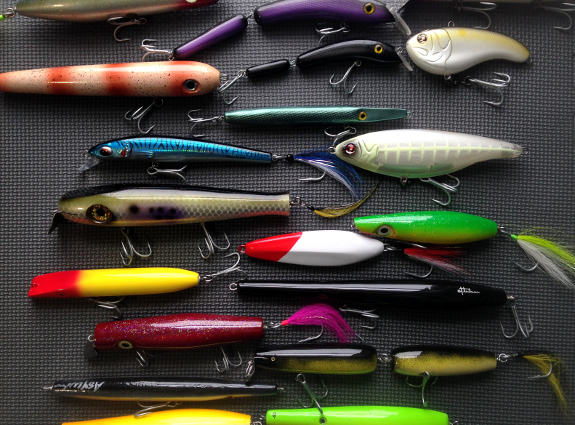
A pedestrian theory on plug colors is that they catch anglers, not fish. I think this theory is wrong. Selecting the right plug color based on the time of year, time of day, depth, and conditions is as important as selecting the size, action, and weight of the plug.

Fish360 Plug Colors

The time of year is important because bait fish populations and migrations are seasonal. Learn what bait fish are in your local waters and when they arrive. Fish colors that complement the swimming bait fish. If there is thick concentration of bait fish, then fish colors that contrast the school of bait fish.

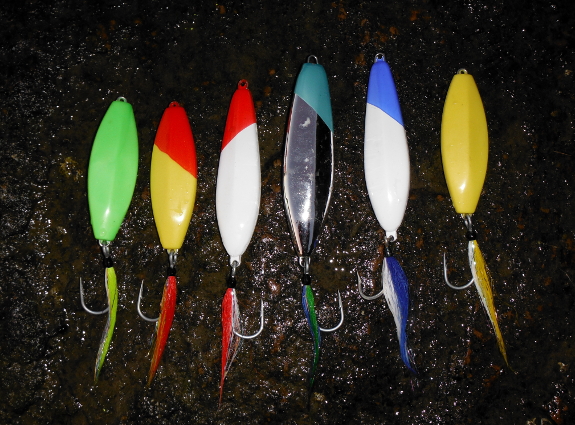
Time of day is key. A proven pattern is light colors by day and dark colors by night. Personally, I tend to favor two-tone color plugs. My day shift plug bag has colors like:

  • Yellow / White
  • Blue / White
  • Green / White
  • Red / White
  • Pink / White
  • Blue Mackerel
  • Green Mackerel

My night shift plug bag has colors like:

  • Black / Yellow
  • Black / Purple
  • Black / Blue
  • Black / Pink
  • Black / Green

The most commonly overlooked parameter by surfcasters is depth. Colors appear different at increasing depths in the water column because light penetration decreases as depth increases. For example, red is not visible as red after 10 feet of water. Hence, my red/white plugs are all top water plugs and my deep swimming plugs have yellow and chartreuse.

Time of day, time of year, and depth are predicable parameters. Conditions are out of our control. No matter how many weather apps your smart phone has, when you get to the water’s edge, the conditions can (and often do) change without warning. For white water or “washing machine” conditions, I like bright and loud colors like:

  • Chartreuse / Yellow
  • Red / Yellow
  • Yellow / Blue
  • Blue / Green

But! If I had to pick three colors, I would fish: yellow, white, and black. You can hook a lot of fish with just these three colors when you fish your plugs properly.

Bottom line, all colors catch fish. The right color at the end of your line is not the newest plug fashion craze. The right color at the end of your line is the color that you have confidence in. Fishing proven colors based on time of year, time of day, depth, and conditions, will help your confidence. Confident anglers catch fish!

Facebooktwitterlinkedin

Owner Beast Hooks

The versatility of soft plastic baits in freshwater and saltwater is awesome! But!! A soft plastic bait will not catch a fish without a hook!!! Selecting the optimal hook for a soft plastic bait requires some consideration.

Fish360 Owner Beast Hooks

The first consideration is hook size. I use the largest hook that will penetrate the soft plastic without negatively impacting the bait’s action. I learned this lesson the hard way when I lost a trophy fish! ;-(

The second consideration is weight. The two selection factors for weight are: the density of the soft plastic and the height of the water column. Frankly, I keep it simple. I rig each soft plastic with an un-weighed hook and a weighted hook. I use a Tactical Anglers Power Clip, which allows me to quickly switch pre-rigged soft plastic baits in seconds. Time is fish!

Fish360 Owner Beast Hooks Soft Plastics

The third consideration is wire thickness. I am sure fine wire hooks have their place. But, it’s not in my Plano boxes! I use strong and sharp hooks. After each trip to the ocean, I rise my hooks with fresh water to keep my hooks sharp.

My first choice hook for thin and medium profile soft plastic baits is the Owner Beast hook. These hooks have strong wire and bleeding sharp points. They are also very well balanced. The are available in 4/0, 6/0, 8/0, and 10/0 sizes. Each size is available un-weighted and weighted: 1/8 oz, 1/4 oz, 3/8 oz, and 1/2 oz. Bottom line, I buy Owner Beast hooks because they hook and land fish!!! 😉

Facebooktwitterlinkedin

Selecting a Surf Rod

During my seminars, I am often asked: “What surf Rod should I get?” This simple question has a complex answer because selecting a surf rod is a process. The process involves a logical series of multi-option questions.

Fish360 Selecting a Surf Rod St. Croix Rods

Are you casing bait, plugs or jigs? If bait, eels or chunks? If chunks, then 1 – 6 oz or 8+ oz of lead and bait? If plugs, what size range? 1 – 3 oz or 3 – 5 oz? If jigs, what weights? 1 – 2 oz or 2 – 6 oz? Where are you fishing? Rivers, back bays, jetties, or surf? Do you skish?

These questions are important become they help to determine the application of your next surf rod. The application, then determines the action, power, material, and length of the blank. The application also determines the guide style and the number and placement of the guides.

Selecting an application specific surf rod is now much easier, thanks to the St. Croix Mojo Surf rods. These rods range from 7′ to 12′ and have casting loads from 3/8 oz to 16 oz. I prefer the blanks with a moderate-fast action because they propel your presentation a great distance and bend parabolically to quickly exhaust large predatory fish. The rods are wrapped for spinning and casting reels. The two piece models have off-set ferrules, which provide one-piece performance. These rods also have a 5 year warranty! 😉

I have been fishing St. Croix rods for 15 years. I currently own 4 Mojo Surf rods. I have an 8′ Mojo Surf spinning rod (Medium Power, Moderate-Fast Action, 3/4 – 3 oz) that I use for freshwater surfcasting and schoolies in back bays. I outcast everyone at reservoirs 3 to 1, on every cast with this rod. I have a 9′ Mojo Surf spinning rod (Medium Power, Moderate-Fast Action, 1 – 4 oz) that I use for eels and 1 – 3 oz plugs/jigs in the surf. This versatile rod has a lot of power for a 9 foot rod! I have a 10’6″ Mojo Surf spinning rod (Medium-Heavy Power, Moderate-Fast Action, 2 – 6 oz) that I use for 3 – 5 oz plugs/jigs and “light” chunking in the surf, rivers, and inlets. The 11′ Mojo Surf spinning rod (Medium-Heavy Power, Moderate-Fast Action, 3 – 8 oz) is an ideal jigging for heavy current inlets like the Cape Cod Canal. I have a 12′ Mojo Surf casting rod (Heavy Power, Moderate-Fast Action, 6 – 16 oz) that I use for “heavy” chunking (eight-and-bait). This rod is a beast! Bottom line, these rods just work, cast after cast.

St. Croix has reduced the complexity of selecting a surf rod by building 14 different Mojo Surf rods for the full spectrum of applications. Check them out at the New England Saltwater Fishing Show.

Facebooktwitterlinkedin

Measuring Fish

There are two ways to measure fish: weight and length. There are several lip grippers on the market that also have calibrated scales to weigh fish. If you are planning to release a fish, then vertically weighing the fish is not the optimal way to measure the fish. Suspending a fish vertically by its lip puts stress on the fish’s internal organs. The bigger the fish, the greater the stress and the less likely the fish will recover and survive. A less stressful way to measure a fish is by length. You can use length charts to estimate the weight of the fish or you can measure the length and girth of the fish and compute it’s weight using the IGFA Fish Weight Formula: ((Girth x Girth) x Length) / 800) lbs.

Fish360 Measuring Fish

In recent years, a retractable vinyl tape measure has gained popularity. I must say that this product is innovative. But, its internal retracting mechanism is fragile and does not last a full season. It also has a limited length. I target BIG fish! 😉

I now use a simple wide vinyl yard ruler, which is commonly used by tailors. No moving parts. Nothing to rust or break. Easy to read. It measures perfectly each and every time. 🙂

Facebooktwitterlinkedin

Roberts Rangers

In Engineering, the best solution is typically the simplest one. Roberts Rangers simple plug design makes them durable, castable, and fishable.

Fish360 Roberts Rangers

Roberts Rangers are made with 304 stainless steel through wire and Acrylonitrile- Butadiene- Styrene (ABS) plastic, which has a high impact resistance. In theory, these high quality materials and a propriety molding process gives Roberts Rangers durability. In practice, Roberts Rangers survive the strong jaws and teeth of bluefish. They bounce off of the rocks on Montauk, Cuttyhunk, and the Cape Cod Canal. I do not know of any other plug on the market that can take this abuse and still be fished.

The areodynamic design and internal weighing of the Roberts Rangers gives the plug awesome castablity. When the fish are far out, I cast a Roberts Ranger. When there is a strong onshore wind, I cast a Roberts Ranger.

The top water action of Roberts Rangers has made them the top bluefish plug since 1970. But! They also catch striped bass, false albacore, bonito, weakfish, Spanish mackerel, peacock bass, European sea bass, giant trevally (a.k.a. GT), bluefin travellay, barracuda, leerfish (a.k.a. queenfish), yellow fin tuna, bluefin tuna, blackfin tuna, barramundi, jack crevalle, tarpon, ladyfish, marlin, and roster fish. Hence, I always carry at least three Roberts Rangers in my plug bag in different colors and sizes. Day or night. From the first day of spring to the last day of fall. I fish them on every trip.

The only modification that I make to my Roberts Rangers is to replace the rear hook with a custom tail. I tie my own tails in matching colors using a multi-layered threading and epoxy process on VMC siwash hooks. This small modification enhances the action and extends the color profile of the plug.

If you fish for inshore species from shore, boat, or kayak, then you best carry Roberts Rangers with you. They are available in sizes from 1 3/4 oz to 4 oz in solid colors like yellow and chrome and two tone colors like red/white and blue/white. You can order them from Roberts Rangers or buy them at the New England Saltwater Fishing Show at 50% off for blems. The fish do not notice blemishes! Trust me!! Stock up!!! 😉

Facebooktwitterlinkedin

Re-Rigging

Targeting predatory fish requires strong and well tied rigs. I make all of my rigs. I never use the same rig for more than one trip. When I land a big figh, I re-rig. When I land a toothy fish, I re-rig. When I drift jigs or chunks across the bottom of an inlet like the Cape Cod Canal, I check my rig before each cast and re-rig if the line has any sign of damage. Time is fish. So I use a simple and strong method to re-rig that I learned from Paul Melnk, the founder of skishing.

Fish360 Re-Rigging

This simple method has two steps. First, tie a Tactical Anglers power clip to your main line via palomor knot (for braid) or improved clinch knot (for monofilament). Second, exchange your rig by sliding the rig’s swivel in or out of the Tactical Anglers power clip, like you would a plug.

I have been using this method for several seasons now. I use it for plug rigs, plug and teaser rigs, and all of my custom chunking rigs. This method works so well that I no longer use the loop-to-loop method—- unless I am fly fishing. 😉

Facebooktwitterlinkedin

Tackle Buddy Soap

Chunking is an effective method to hook and land fish. Chunking is also messy and smelly. If your hands do not get dirty, you are not chunking. Thankfully, Tackle Buddy Soap solves this problem!

Fish360 Tackle Buddy Soap

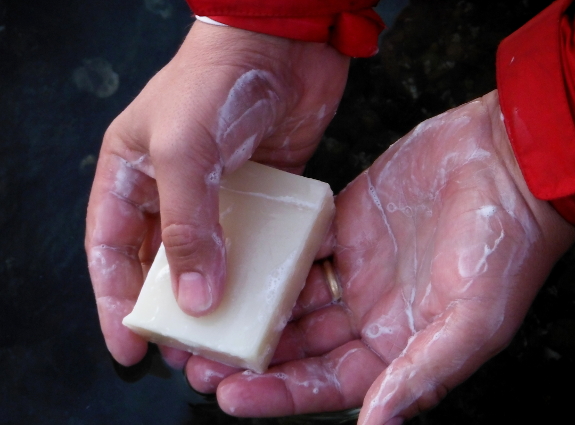
When Rochelle Chavier told me about Tackle Buddy Soap at the New England Saltwater Fishing Show this past February, I was skeptical. Lather in saltwater? Really? My skepticism sprouted from my Liberal Arts, Scientific, and Technical education. Well! I am happy to write that the soap does not only lather in saltwater, it also cleaned my messy hands and left them fish smell free!

In addition to it’s cleaning performance, Tackle Buddy Soap is also ecologically friendly. In fact, it’s 100% all natural. I have been using baby wipes for years now. They clean messy hands as well as they clean baby bottoms. But, now with Tackle Buddy Soap, I carry less and I have a zero percent footprint in our overgrowing landfills. Now that’s a win-win! 😉

Tackle Buddy Soap is hand made in Lakeville, Massachusetts. You can order your bars directly from TackleBuddySoap.com or you can stock up at the up coming New England Saltwater Fishing Show and save on $hipping! 😉

I keep my Tackle Buddy Soap in a small water proof Plano box inside my chucking cooler. Like Rochelle’s husband, who is a commercial fisherman, I never go chunking without my Tackle Buddy Soap!

Facebooktwitterlinkedin

Guppy Pencil Poppers

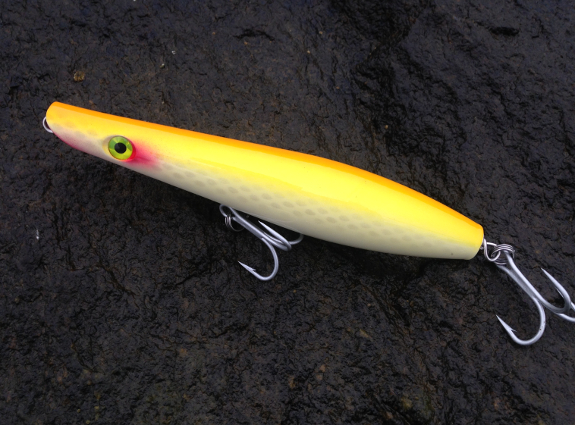
A pencil popper is the most versatile top water plug. A pencil popper can be fished in the surf, in inlets, in clam conditions, in rough conditions, during the day, and at night. I fish Guppy pencil poppers because they are well built, field tested, and optimized for casting distance and action.

Fish360 Guppy Pencil Popper

Wayne Hess, the owner of Guppy Lures, makes five different pencil poppers that range from 1 1/4 oz to 3 1/2 oz. Each Guppy pencil popper is hand built with through-wire construction. A 1/16″ diameter stainless steel wire is passed through the center of the plug. The belly hook is a VMC 4X treble hook (1/0 to 4/0) that is secured to a Krok stainless steel barrel swivel (220 lb to 500 lbs) via Wolverine split ring. The tail hook is also a VMC 4X treble hook (1/0 to 4/0) that is secured to through-wire via Wolverine split ring. Each plug is painted in one of 19 different color patterns using a complex process that incorporates a sealer to eliminate water intrusion, primer, and a clear coat.

I have caught fish in inlets with a round bottom pencil popper. I have caught fish in the surf with a flat bottom pencil popper. Both styles catch fish in the surf and in inlets. But! If I have room for only one pencil popper in my plug bag, it’s going to a Guppy flat bottom (a.k.a. “Canal Special”) pencil popper. Why? Because they casts farther. Their flat bottoms allow the plug to rise to the surf quickly after they sink into the water at the end of the cast.

Some pencil poppers on the market require some modifications before use. For example, replacing weak split rings and fragile hooks. The only modification that I make to my Guppy pencil poppers is to replace the rear treble hook with a custom tied VMC siwash hook. I tie my own tails in matching colors using a multi-layered threading and epoxy process. This small modification enhances the action and extends the color profile of the plug.

Fish360 Tails

Do you own a Guppy pencil popper? If you do not, buy one! If you do, but another one!! Fish them in inlets. Fish them in the surf. Be sure to hold onto your rod….the strikes are explosive!!!

Facebooktwitterlinkedin