“Metal Lip Tuning Tips” by Dave Anderson

I was wading through the Internet recently when I bumped into an article called “Metal Lip Tuning Tips” by Dave Anderson on the fifth issue of Surfcasters Jounal.  I had to read the article from start to finish right then and there.  Why?   Because!  One, I love fishing metal lip plugs.  Two, it was written by Dave Anderson, the outdoor writer and lure builder.

In his article, Dave Anderson goes far beyond the “how to make a metal lip plug swim higher or lower in the water column” discussion.  From nail polish to securing egg sinkers to the bellies of metal lips, Dave Anderson leaves nothing out.  The article has more tips on tuning metal lip plugs than any other article or book I have read— and I am well read!  ;-).

I have read several of Dave Anderson’s articles in print.  I am glad his writing style and story telling skill remains unchanged online.

Facebooktwitterlinkedin

Holiday Gift Ideas For Anglers

This month I have been bombarded by emails and articles on holiday gift ideas for anglers.  Some good, some bad, and some really, really bad.  The best one for 2010 is The Saltwater Edge video:

If you are shopping for an angler, then avoid the “bombs” and get some useful suggestions from Arden Gardell.  Your angler will not be disappointed!

Facebooktwitterlinkedin

Selecting a Fly Rod

I am in the market for my first fly rod.  My quest for a fishconomic fly rod has generated more questions than answers.  In fact, my  research has left me in a state of “paralysis by analysis”.   That is, until I read  “Don’t Fear The Fly Rod” by Joseph Manette.

Manette’s article starts with a technical comparison of spin fishing and fly fishing; the best I have ever read, actually!  Manette then wades deeper into the subject and describes fly lines and the four fly rod classes:

  1. Light Tackle    (3 – 5 wt)
  2. Finesse Tackle (6 – 7 wt)
  3. Power Tackle   (8 – 10 wt)
  4. Heave Tackle   (11 – 15 wt)

In the second half of the article, Manette gives practical advise on selecting your first fly rod and fly casting.

If you are at all curious about fly fishing, pick up the December 2010 issue of On The Water, New York & New Jersey Edition.  You will not be disappointed!  Why?  Because “Don’t Fear The Fly Rod” is a well written, comprehensive, and concise guide to transition from spinning rod to fly rod.

Facebooktwitterlinkedin

ZeeBaas Reel Maintenance

In the general maintenance video, Tim shows how to break down a ZeeBaas reel in less than 3 minutes by removing 9 screws.  He then demonstrates how to inspect the O-rings and re-lubricate.  In the advanced videos he covers:

  1. Spool Pinion Housing Maintenace
  2. Gear Maintenance
  3. Pinion Housing Maintenance

The required tools to perform these advanced maintenance operations include:

  1. An external retaining ring tool from Emperial to remove the clips
  2. A gear seal tool to push the gear seal into the gear cover
  3. The ZeeBaas Pinion removal tool
  4. A metal rod less than 9500th thick

ZeeBaas Self Service Maintenance I

ZeeBaas Self Service Maintenance II

These videos will give you the confidence to break down your ZeeBaas reel, service it, and put is back together.  Tight lines and screaming reels. ;-).

Facebooktwitterlinkedin

AquaPac Water Proof Bag

I was wet wading with a friend on Craine’s Beach in Massachusetts. We started fishing before sunrise. As the sun started to rise, a fish rose up and smacked a Stillwater Lures Smack-it popper. The fish was pulling line like the drag was not set. We were waist deep, so we waded back to the beach. We had no idea what fish was on, but we knew it was big. After some tough give and take, my friend landed the fish: a 15 pound bluefish whose girth had gator-like proportions! My friend pulled out his mobile phone to take a picture and to his unpleasant surprise the phone was swimming in sea water. The “water proof” bag he bought to protect his electronic devices failed! Unacceptable.

Fish360 AuquaPac

The following day I was in Maine motoring through the Kittery Trading Postwhen I noticed the same “water proof” bag that failed my friend and a bag by AquaPac. I purchased the AquaPac. But, before I could recommend it to my friend, I tested it. I placed a dry $100.00 USD bill inside the AquaPac and held it below water via 16 ounces of lead:

After 36 minutes, I removed the AquaPac and recovered my money. The AquaPac kept my $100.00 USD bill 100% dry! I now use the AquaPac during my fishing trips and when I go to the beach. I may forget my bait or sunscreen, but I cannot afford to forget my AquaPac. ;-).

Facebooktwitterlinkedin

Getting to the Point

The one thing that unites all fisherman (saltwater, fresh water, boat, shore, bait, lures, or flies) is the hook. The best rod, reel, line, bait, and perfectly tied knots will not land quality fish consistently without the aid of a strong, sharp, and penetrating hook.

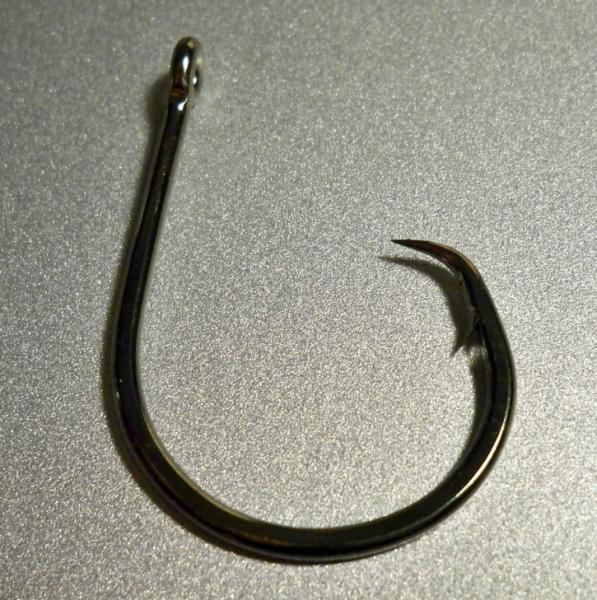
My selection of a hook starts with the species that I am targeting and the method, which in turn define the appropriate hook geometry. For example, when I target Stripped bass and Bluefish from the shore or boat via mackerel, menhaden, herring, clams, sea worms, or eels, my first choice is the Owner SSW In-Line Circle Hook:
Fish360 Hook

This hook is sharp! It’s point can penetrates my fingers with minimal force. I NEVER leave home without band aids and waterproof first aid tape.  This hook is also strong!  It’s fabricated with high quality wire that is fully round.

Fish360 Hook

I like the geometry of this hook.  First, I like the in-line point; from my experience, circle hooks with off-set points gouge and penetrate internal organs. Second, I like the wide gap between the point and the shank, which I believe facilities penetration.  Thirdly, I like the “belly” of the hook because it allows for a good sized chunk to be hung. These physical characteristics have contributed to more landed fish than any other—particularity on nights when the fish are spooky and selective about their meals.

When the conditions are right, I switch over to a J-Hook. My top choice J-hook that landed Striped bass and bluefish consistently from shore or boat that was:

Fish360 Hook

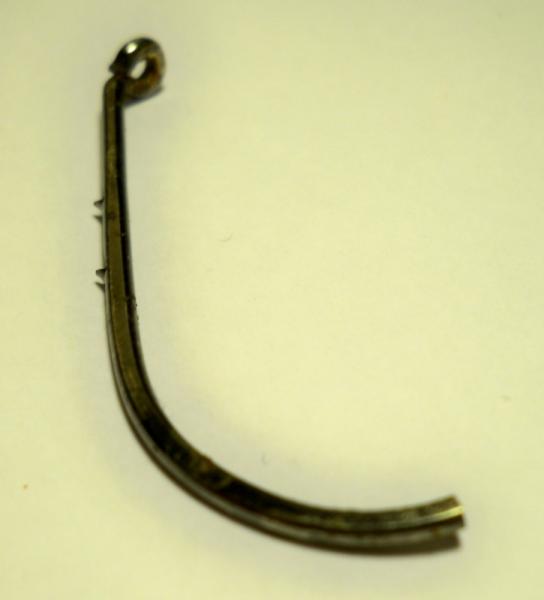
That is until a fish of a lifetime snapped it at the “bend” during the last fall run:
Fish360 Hook

This hook does have a sharp point.  And it does penetrates well.  But!  It’s not strong enough for trophy fish.  The strength of a hook is determined by several factors; but all factors being equal, it comes down to wire thickness.  The thicker the wire, the stronger the hook; but, the slower the penetration speed.  Hence, a hook needs to be “just thick enough” for the species you are targeting.

After Goole’ing to the last page on the Internet, I narrowed down the candidate list to two models, from two different manufactures.  Unable to decide, I called Owner directly to get additional technical details.  The knowledgeable person who returned my voice mail, listened to my story and recommended the Owner SSW hook.

Fish360 Hook

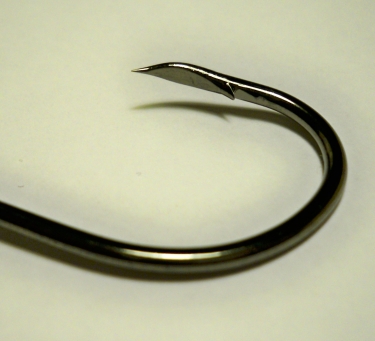
The “Cutting Point” validates the sharpness of this hook:
Fish360 Hook

I am convinced that it’s stronger than its predecessor because it’s wire is fully round, thicker, and of higher quality material. (Yes!  I did measure the thickness of the wire via vernier caliper.)

When I am targeting trophy fish via plugs, sharp and strong treble hooks are not a option. The plug itself can give the fish additional leverage to straighten a hook. The pedestrian hooks that decorate the plugs of trophy hunting anglers are VMC 4X treble hooks— for good reason!  However, for this upcoming season, I am going to replace my VMCs with the Owner 4x treble hooks. Why?

“My preference is the Owner 4x-strong “ST” (for super tinned) trebles. I have never found a treble hook that could match their strength, sharpness and anit-corrosion properties.  It’s as simple as that.”

– Leo N. Orsi. Striper Chronicles East Coast Surf fishing Legends and Adventures.

Getting to the point, when it comes to selecting a sharp, strong, and penetrating hook, I start with Owner because they have bleeding sharp points and “just thick enough” wire for the species being targeted.  Owner hooks deliver awesome penetration.

Facebooktwitterlinkedin

From Spinning to Conventional

Generally speaking, there are two types of fishing reels:

  1. Spinning reels
  2. Conventional reels

Each type of reel has its strong and week points. Some fisherman pick one or the other; some fish both, depending on the application and conditions.

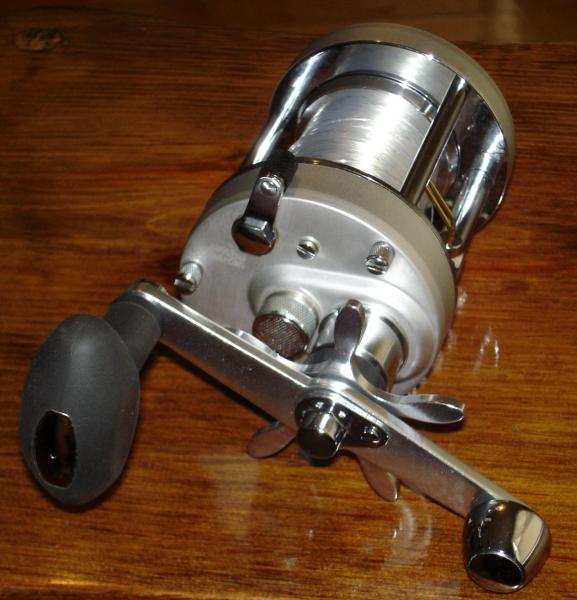
After years of trepidation, I have finally made the decision to fish bait and large plugs from the surf via conventional; leaving my go-to spinning outfit for small to medium plugs. The first stop on my journey was to buy a conventional reel. There number and variations of conventional reels on the market is mind numbing. So, I turned the the experts at Striped-Bass.com (Thank you: maddog2020, steve, Rosepointbass, likwid, ThrowingTimber, spence, numbskull, 5/0, Nebe, and chunk). So, without further a do, let me introduce the newest tenant in my tackle box— Mr. Abu Garcia7000IC:

Fish360 Abu 7000 ic3

I got this particular reel because…

  1. Level-wind
  2. Carbon Matrix Drag system
  3. Large handle and knob
  4. Large capacity (17lb test/325 yards)
  5. Two breaking systems to tune spool speed during casting
  6. Customize-ability via upgrade kits
  7. Great value at $150.00 USD

Tips & Tricks

  1. Do not use a spinning rod!
  2. A swivel is optional.
  3. Lubricate after each trip (as indicated in the product manual).
  4. Fully service at least once a year (or more depending on frequency of use).
  5. Replace the stock bearings with ceramic bearings: increases spool speed and casting distance by reducing friction during casting
  6. Braid vs Mono
    1. Braid gives more feedback when jigging and facilitates staying in touch with plugs
    2. Braid increases the probability of backlashes
    3. If going to use braid, try a heavy weight (e.g. 50+ lb) or 20 lb Fireline
    4. Generally speaking, line diameter is not as critical as with spinning reels; braid may increase casting distance in certain applications— but, opinions vary on this one.
    5. Some pedestrian mono weights are 25 lb Berkely Big Game and 30 lb Ande
  7. When casting and retrieving plugs, the line does not wind as tightly as when casting and retrieving slugs of lead and bait. I would tie on a 2 oz Kastmaster or Crippled Herring and make a few casts and retrieves; this will get the line tightly wound again.
Facebooktwitterlinkedin